
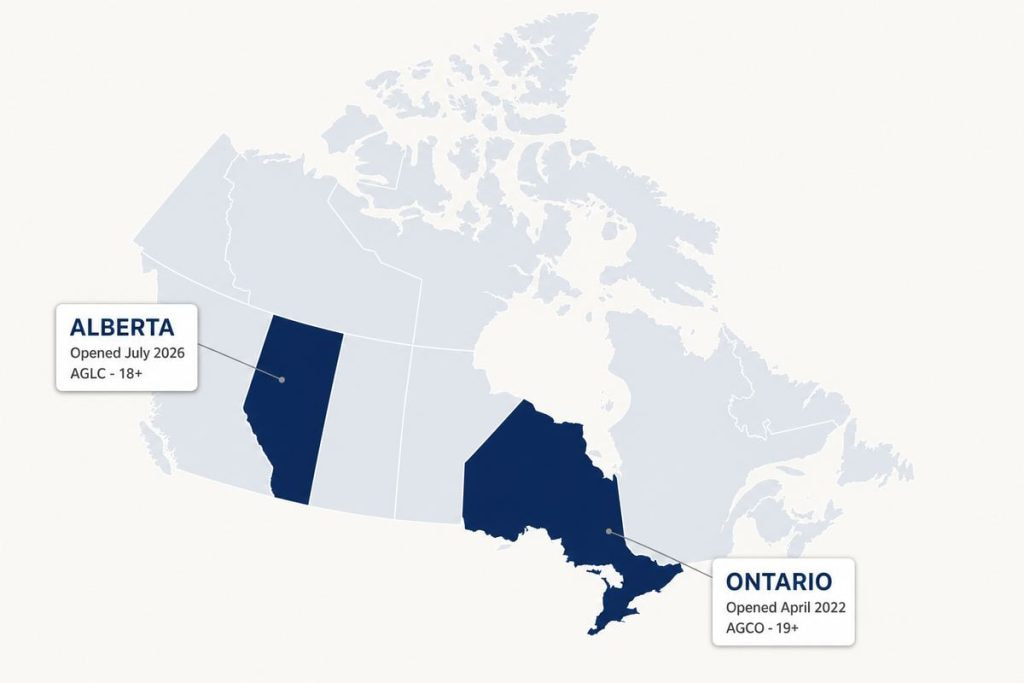
Alberta opened Canada’s second regulated online gambling market on 13 July 2026. More than 20 private operator sites went live on day one, and 50 operators had completed registration with Alberta Gaming, Liquor and Cannabis by launch.
For Ontario players, the immediate answer is that nothing changes. The longer answer involves poker, and it’s the reason this launch is worth paying attention to.
What launched on 13 July
Alberta’s market was built on the iGaming Alberta Act, formerly Bill 48, which received royal assent in May 2025. It set up a two-body structure closely modelled on Ontario’s.
- The Alberta iGaming Corporation conducts and manages the market; the role iGaming Ontario plays here
- Alberta Gaming, Liquor and Cannabis regulates it; the role the AGCO plays here
- Private operators compete alongside the government-owned Play Alberta, as they do alongside OLG.ca in Ontario
Alberta also launched with something Ontario took four years to build: system-wide self-exclusion and centralized financial and time-based limit tools were live on day one, and every operator must integrate with AGLC’s central self-exclusion system. Ontario’s equivalent, BetGuard, arrived in May 2026. The province’s own summary of the plan is at alberta.ca.
How Alberta’s market differs from Ontario’s
| Ontario | Alberta | |
|---|---|---|
| Market opened | 4 April 2022 | 13 July 2026 |
| Regulator | AGCO | AGLC |
| Conducts and manages | iGaming Ontario | Alberta iGaming Corporation |
| Government-run site | OLG.ca | Play Alberta |
| Minimum age | 19 | 18 |
| Central self-exclusion | BetGuard, live May 2026 | Live at launch |
| Poker player pool | Players physically in Ontario | Players physically in Alberta |
There is also the age difference. Alberta’s minimum gambling age is 18, and Ontario’s is 19. The age that applies to you is the age of the province you’re physically in, and Ontario sites will not register a player under 19.
The poker liquidity question
This is the part with real consequences for Ontario players, and it concerns one game.
Why the ring fence hurts poker specifically
Ontario’s poker rooms are peer-to-peer and ring-fenced. You can only play against other people physically located in Ontario. That’s a hard constraint on a game where the product quality depends on how many people are sitting down: fewer players mean fewer tables, smaller tournament fields, less choice of stake and worse availability outside peak hours. Poker was 2% of Ontario wagering in 2024-25, and the ring fence is a large part of why.
What the November 2025 ruling changed
In November 2025, an Ontario court reference confirmed that shared poker liquidity between provinces is legal, provided the two provinces sign a formal agreement to do it. That ruling is summarized in this article.
Alberta launched ring-fenced poker anyway. There was no agreement in place on day one, so Albertans play Albertans and Ontarians play Ontarians, but both provinces have said they’re working toward an arrangement that would combine the pools, along the lines of the multi-state agreement that links several US poker markets.
If that agreement is signed, Ontario poker players get a materially better game without changing sites: more tables running, bigger guaranteed tournaments and better off-peak traffic. It’s the single biggest improvement available to regulated poker in this country, and it doesn’t require any new legislation. It requires two governments to sign the same document.
Can you play on an Alberta site from Ontario?
No. Both markets are geolocated, and an operator licensed in Alberta can only accept wagers from players physically in Alberta. The reverse applies too.
Several operators hold licenses in both provinces, so you may recognize the brand names. The accounts, balances, promotional terms and player pools are separate. A trip to Calgary doesn’t let you keep playing on your Ontario account, and an Alberta account won’t work when you get home.
What actually changes for Ontario players
- More operators have a reason to invest in Canadian product. A brand serving two regulated provinces instead of one can justify Canadian support hours, Canadian game selection and Canadian payment rails, which is the part Ontario players notice first at the real money cashier.
- Poker has a route out of the ring fence. It needs an interprovincial agreement, not a court case or a new act.
- Ontario’s model has been adopted rather than replaced. Alberta looked at a Crown monopoly and chose competitive licensing with a central regulator instead, which signals where any further provinces are likely to land.
The sites you can play at, the age you have to be, the operator you’re registered with, or the protections that apply to you don’t change. Those are all still set in Ontario.
What to watch next
- An Ontario and Alberta shared liquidity agreement, which is the only development here that would change an Ontario player’s experience directly
- Alberta’s first published wagering and revenue figures, which give the first real comparison of a second Canadian market against Ontario’s early years
- Whether British Columbia or another province moves next, and whether it copies Alberta’s version or Ontario’s
We’ll cover the liquidity agreement here if and when it’s signed. Until then, Ontario players can find the licensed operators available to them on our Ontario casino rankings, and how the province’s licensing works on our Ontario online gambling guide.
You must be 19 or older to gamble online in Ontario. If gambling is causing problems for you or someone you know, ConnexOntario offers free, confidential support 24 hours a day at 1-866-531-2600.