
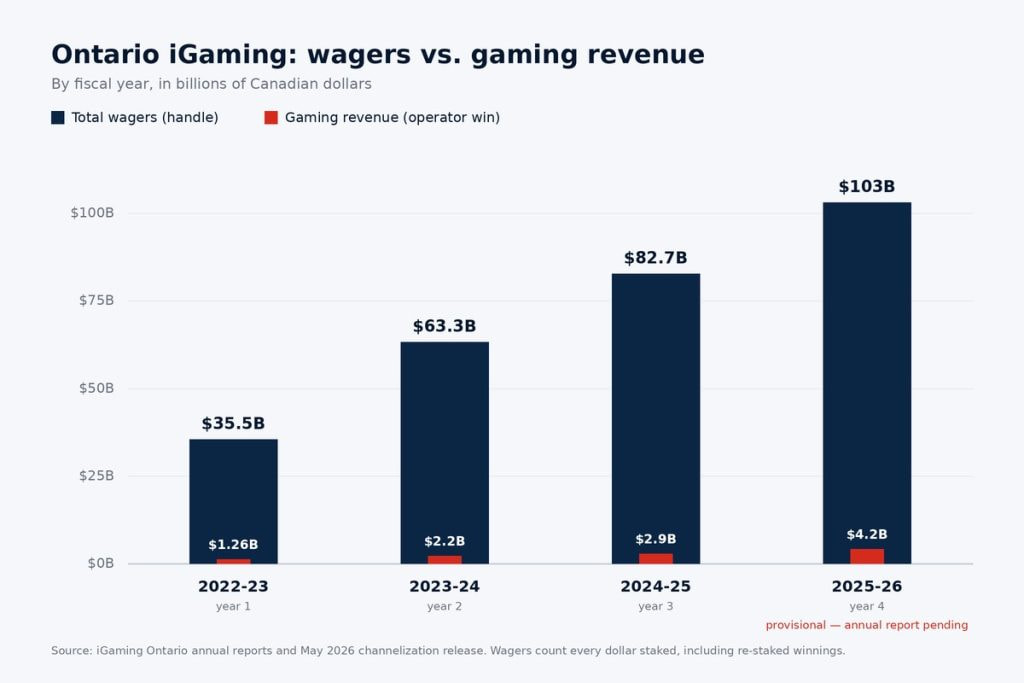
Ontario’s regulated online market opened on April 4, 2022. In its fourth year, iGaming Ontario reported more than $103 billion wagered and over $4.2 billion in gaming revenue.
The number that matters more to players is smaller and less quoted: 91.1% of Ontarians who gamble online now do it on regulated sites, up from 83.7% a year earlier.
Here’s what four years of published data shows, and what it leaves out.
Where the market stands after four years
iGaming Ontario publishes wagering and revenue figures in its annual reports and, since January 2025, monthly. The annual series looks like this:
| Fiscal year | Total wagers | Total gaming revenue | Active player accounts |
|---|---|---|---|
| 2022-23 (year 1) | $35.5 billion | $1.26 billion | 1.6 million |
| 2023-24 (year 2) | $63.3 billion | $2.2 billion | 2.1 million |
| 2024-25 (year 3) | $82.7 billion | $2.9 billion | 2.6 million |
| 2025-26 (year 4) | Over $103 billion | Over $4.2 billion | Not yet published |
Growth has slowed in percentage terms while continuing in absolute ones. Wagering rose 78% in year two, 32% in year three and roughly a quarter in year four. That’s the shape of a market that has finished recruiting and started compounding.
The year-four figures come from iGO’s May 2026 channelization release. At the time of publishing, the full 2025-26 annual report hasn’t been published, so the account and product breakdowns for that year aren’t available. Monthly data is current to June 2026 in iGO’s market performance report.
Wagers and revenue are not the same thing
The $103 billion figure gets reported as if Ontarians handed over $103 billion. This is untrue, as wagers, or handle, count every dollar staked, including dollars that were won and staked again.
The same $20 recycled through fifty spins registers as $1,000 in wagers. Gaming revenue is what operators actually kept, and in year four that was $4.2 billion against $103 billion staked: about 4%.
That 4% is the market-wide house edge in aggregate, and it’s the honest way to read the headline. It’s also why the wagering number grows faster than the revenue number in years when slot play, which recycles fastest, grows fastest.
Casino, sports and poker
Year three is the most recent year with a published breakdown. Of $82.7 billion wagered:
- Casino games took $69.7 billion, or 84% of wagers, and produced $2.189 billion in revenue, or 75%
- Betting took $11.4 billion, or 14% of wagers, and produced $653.8 million, or 23%
- Peer-to-peer poker took $1.7 billion, or 2% of wagers, and produced $58.6 million, or 2%
The gap between casino’s 84% of wagers and 75% of revenue is the recycling effect again: slots and live dealer tables turn over stakes far faster than a sports bet does, so they generate more handle per dollar deposited and a lower revenue share relative to it.
Sports betting gets most of the advertising and roughly one seventh of the wagering. Casino is the market.
The number that matters most: 91%
Channelization measures the share of online gamblers playing on licensed sites rather than offshore ones. An Ipsos study commissioned by the AGCO and iGO has tracked it since the market opened.
How the figure has moved
- 2023: 85.3%
- February 2024: 86.4%
- 2025: 83.7%
- 2026: 91.1%
The 2026 figure is a 7.4 percentage point jump, and players reporting they used only unregulated sites fell from 16.3% to 8.9%. The AGCO’s announcement attributes this change to growing confidence in mandatory player protections.
Why it matters more than the wagering record
Channelization is the only figure in the set that measures whether the market is doing its job. Wagering growth tells you the market is popular. Channelization tells you how much of a province’s online gambling sits inside a system with verified identity, mandatory limit-setting tools, segregated player funds and a regulator that accepts complaints. The remaining 8.9% has none of that.
Year four’s other change: BetGuard
On May 14, 2026, iGO launched BetGuard, a centralized self-exclusion system covering the whole regulated market. It is the most consequential thing that happened to Ontario players in year four, and it got a fraction of the coverage the wagering records did.
Before BetGuard, self-excluding meant contacting each operator separately, one at a time, across more than 80 gaming sites. Now:
- One registration blocks access to more than 70 regulated iGaming brands
- You don’t need an existing account with any operator to sign up
- Registration takes under ten minutes with a mobile device and a piece of ID
- Terms available are six months, one year, five years, or a custom period
- Operators must suspend existing accounts immediately, including active sessions, and must check every new account application against the database
- Registrants stop receiving marketing from all regulated operators
It’s at betguard.ca. Ontario is now one of a small number of jurisdictions with market-wide digital self-exclusion rather than per-operator opt-outs.
What the data doesn’t tell you
The published figures are operator-side accounting. The three things they don’t measure:
- How losses are distributed. Aggregate revenue of $4.2 billion says nothing about whether it came evenly from millions of players or disproportionately from a small number of heavy losers. No breakdown is published.
- How many people are playing. Active player accounts are accounts, not individuals. One person holding accounts at six operators counts six times, which makes the year-on-year account growth an unreliable proxy for participation.
- Whether harm is rising or falling. Wagering volume and gambling harm are different measurements, and Ontario doesn’t publish the second alongside the first.
None of that makes the reported figures incorrect, but it does make them a partial picture.
What this means if you play in Ontario
Four years in, the practical case for staying inside the regulated market is no longer theoretical. Licensed operators verify identity, hold player funds separately from operating funds, must offer deposit and time limits, are barred from advertising inducements publicly, and answer to a regulator that accepts player complaints. BetGuard now applies across all of them at once.
If you want to check that a site is licensed here, the operator list is published by iGO, and every site on our Ontario casino rankings is AGCO-registered. Our Ontario online gambling guide covers how the licensing works.
You must be 19 or older to gamble online in Ontario. If gambling is causing problems for you or someone you know, ConnexOntario offers free, confidential support 24 hours a day at 1-866-531-2600.