
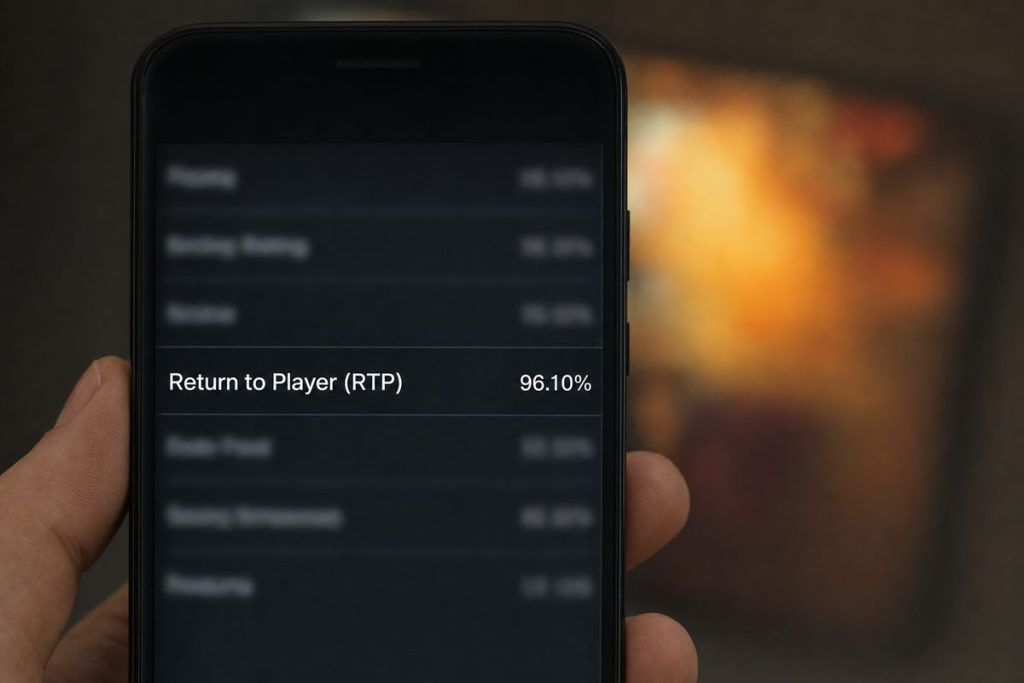
RTP, house edge and volatility describe three different things, but they get used as if they were interchangeable. RTP tells you what a game returns across millions of rounds. House edge tells you what it keeps, and volatility tells you nothing about either, only about how the money arrives.
Get the three terms straight, and you can compare a slot to a blackjack table honestly, which is something most comparisons don’t manage.
Three numbers, three different jobs
- RTP (return to player) is the percentage of all money wagered that a game pays back over its full theoretical cycle. A 96% RTP slot returns $96 for every $100 staked, on average, over millions of spins.
- House edge is the same information stated from the casino’s side: the percentage of each wager the operator expects to keep. A 96% RTP is a 4% house edge. The two percentages always add to 100%.
- Volatility (or variance) describes the distribution of those returns. Two games with identical RTP can pay in small, frequent amounts or in rare, large ones. Volatility is the difference between them.
The first two are the same measurement. The third is unrelated to both, and it’s the one that determines what a session actually feels like.
RTP: what the game returns over time
RTP is calculated by the game’s developer from its mathematics, then verified by an independent testing lab before the game is certified for a regulated market. It isn’t an observed figure from real play. It’s the theoretical output of the game’s pay table and reel weightings, computed over the full cycle.
The size of that cycle is the part that gets skipped. For a typical online slot, the theoretical cycle runs to tens of millions of spins. It’s impractical for the cycle to be an observed figure, as a player doing 500 spins an hour would need roughly 20,000 hours to complete one.
Why RTP tells you nothing about tonight
Over a single session, RTP has almost no predictive value. A 96% RTP slot will return anywhere from nothing to several thousand times your stake across 500 spins. The 96% is the average of a distribution so wide that the average is not a useful forecast of any individual result.
RTP doesn’t promise you’ll lose 4%; in fact, it doesn’t promise you’ll lose at all. It says that if you play long enough, your results converge on losing 4% of everything you’ve staked, and “long enough” is longer than a recreational player will ever play.
RTP is not always fixed per game
Some studios ship a single game in multiple RTP configurations, for example 96.1%, 94.2% and 92.0%, and the operator selects which one to deploy. The same slot with the same name and artwork can carry a different RTP at two different sites.
The figure that applies is the one in the game’s own information panel, not the one on a review page. Check it there and check it again if you move the same game to a different operator. The sites with the largest certified slot catalogues in Ontario are listed on our Ontario slots page.
House edge: the casino’s cut
House edge is the more useful number for table games, for a mechanical reason: table games have a fixed set of rules and a known correct strategy, so the edge is a precise figure rather than a design target.
European roulette has a 2.70% house edge because there are 37 pockets and a single-number win pays 35 to 1. That gap is the entire edge, and no betting pattern changes it. American roulette adds a second zero, taking the same bet to a 5.26% edge. The two games look nearly identical, and one of them costs almost twice as much to play.
Blackjack is different again, because the edge depends on your decisions. Under liberal rules with correct basic strategy, it sits near 0.5%. Play by instinct instead, and it rises to somewhere between 2% and 4%. It’s one of the few games where the published figure is conditional on the player, and the strategy behind it is covered on our Ontario blackjack page.
Volatility: how the money arrives
Volatility describes the shape of the returns rather than their size. It doesn’t change RTP by a single decimal place. What it changes is how long your bankroll survives while the RTP does its work.
- Low volatility: frequent small wins, shallow losing runs. Sessions last longer on the same bankroll and rarely produce a memorable result in either direction.
- Medium volatility: the default setting for most mainstream slots, and a deliberate compromise between the two.
- High volatility: long dry stretches punctuated by rare large payouts. The advertised maximum win is usually attached to a high volatility game, and so is the risk of losing a full bankroll without triggering a single feature.
A practical consequence: on a high volatility game, the bet size that keeps you comfortable is smaller than the one you’d pick on a low volatility game with the same RTP. Most players don’t adjust, which is why identical RTP games produce such different complaints.
Typical figures by game
Table game figures below assume correct strategy and standard rules. Slot ranges reflect what regulated markets typically certify. Figures are approximate standard published values.
| Game | RTP | House edge |
|---|---|---|
| Video poker, 9/6 Jacks or Better, optimal play | 99.54% | 0.46% |
| Blackjack, basic strategy, liberal rules | ~99.5% | ~0.5% |
| Baccarat, banker bet | 98.94% | 1.06% |
| Baccarat, player bet | 98.76% | 1.24% |
| Craps, pass line | 98.59% | 1.41% |
| European roulette, single zero | 97.30% | 2.70% |
| Online slots, typical range | 92% to 97% | 3% to 8% |
| American roulette, double zero | 94.74% | 5.26% |
| Baccarat, tie bet | ~85.6% | ~14.4% |
The spread from top to bottom is a factor of thirty. Two of the worst bets on the list sit at the same table as one of the best.
Turning the numbers into dollars per hour
House edge applies to every dollar wagered, not to the money you brought. So the figure that decides your hourly cost is total handle, and handle is bet size multiplied by rounds per hour.
Three players, three very different games:
- $1 per spin on a 96% RTP slot, 500 spins an hour: $500 wagered, expected cost $20 an hour
- $10 per spin on European roulette, 45 spins an hour: $450 wagered, expected cost $12.15 an hour
- $25 per hand on blackjack with basic strategy, 80 hands an hour: $2,000 wagered, expected cost $10 an hour
The $1 slot player has the highest expected hourly loss and the smallest bet on the table. Speed and edge together decide the cost, and slots are by far the fastest game in the building. This is the calculation that makes “I only bet a dollar” misleading.
It’s also the number to use for a session budget. Pick the loss you’re willing to treat as the price of the entertainment, then work backwards to a bet size and a duration that fit it.
Four things players get wrong
- Treating RTP as a session forecast. It’s a limit approached over millions of rounds, not a prediction for 500 spins.
- Assuming a higher RTP game is cheaper regardless of speed. A 97% slot played at 700 spins an hour costs more per hour than a 95% slot played at 300.
- Believing volatility affects RTP. It doesn’t. It changes the path, not the destination.
- Expecting a game to be “due”. Every spin and every deal is independent. A slot that hasn’t paid in 400 spins has the same odds on spin 401 as it did on spin 1.
Conclusion
Check the RTP in the game’s information panel rather than trusting a figure quoted elsewhere. Use house edge to compare table games and bets within a game. Use volatility to set your bet size rather than to pick your game, and calculate your expected hourly cost before you sit down, because that number is the one you’ll actually be paying. Use deposit and loss limits to keep yourself accountable.
Games with the lowest edges available at licensed Ontario sites are listed on our blackjack, roulette and live dealer pages, and the operators carrying them are ranked on our Ontario casino rankings.
You must be 19 or older to gamble online in Ontario. If gambling is causing problems for you or someone you know, ConnexOntario offers free, confidential support 24 hours a day at 1-866-531-2600.