

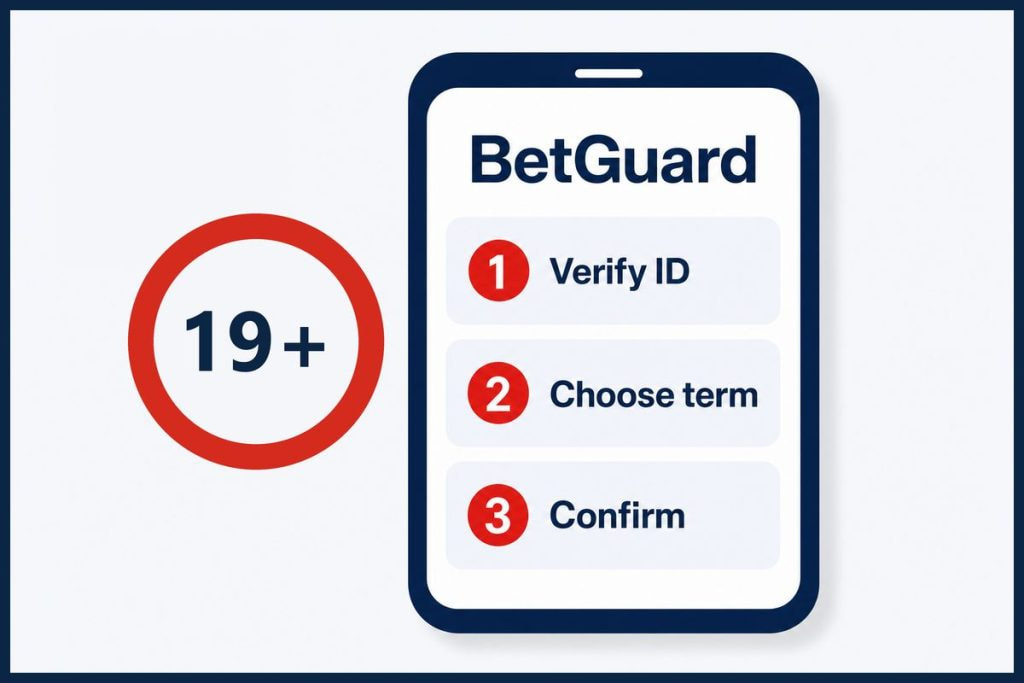
BetGuard went live on May 14, 2026. With a single registration, a player looking to stop playing for a period of time can block every online gambling site registered with the AGCO immediately and without creating any casino accounts.
That was BetGuard’s promise, and three months in, it’s clear what BetGuard reaches and what it doesn’t. Let’s examine what BetGuard blocks, how registration works, what happens when a term ends, and the three gaps it leaves open.
What BetGuard is
BetGuard is a centralized self-exclusion register run by iGaming Ontario at betguard.ca. It has been live and accepting registrations since May 14, 2026.
The program covers every online gambling site registered with the AGCO, including OLG’s online products. You register once, your details go into a central registry, and regulated operators match against that registry to stop you logging into an existing account or opening a new one. One barrier across the whole regulated market, rather than one barrier per site.
When you register, operators block three things: access to accounts you already hold, new account registrations, and direct marketing from regulated operators.
To register, you must be 19 or older and have one valid government photo ID, a permanent Canadian or US address, a cellphone, and an email address. The service runs in English and French, and setup takes about five minutes.
Terms run from six months to five years. Preset options are six months, one year, and five years, or you can set a custom length.
The ID verification step is what makes the rest of it work. Operators match you by verified identity rather than by email address, and that’s why the exclusion reaches sites you’ve never signed up with. It’s also why you can’t register on someone else’s behalf.
What BetGuard replaced
Before May, self-exclusion in Ontario was an operator-by-operator job. Every site ran its own program with its own form, term lengths, and rules for coming back. You could only use it if you already had an account, so any site you hadn’t joined stayed open.
For anyone trying to step away from online gambling entirely, that meant dozens of separate processes, completed one at a time, with no single record that any of it had happened. It created friction in a system that was already difficult for some players to navigate. While the old system let players opt out, it forced them to revisit casinos repeatedly.
BetGuard replaced that process with one registration that reaches more than 75 sites.
What happens once you’re registered
Within an hour of registering, your name appears on a central registry, and after the enrolment is finalized, operators must log you out. Operators of online gambling sites in Ontario are given up to 24 hours to act. Inside that window, they have to lock the account, cancel any outstanding wagers and return your full balance. After that:
- You can’t log in to accounts you already hold at registered sites.
- You can’t open new accounts.
- Within 24 hours, direct marketing from registered operators stops.
Once you register for BetGuard, you can’t change your mind. A term can be extended, but it can’t be shortened or cancelled once it’s running. That’s deliberate, because self-exclusion is built to be a decision you make once, while you’re thinking clearly, rather than one you make and then want to renegotiate at midnight.
Three months in
Uptake was reported unofficially at more than 500 registrations in the first two weeks. iGaming Ontario hasn’t published a running total since, so there’s no three-month figure to compare it against, and no public breakdown of which terms people are choosing.
However, regardless of how many people use it, BetGuard is a free and valuable service that is being used, even if exact numbers haven’t been determined yet.
What BetGuard doesn’t cover
While BetGuard is a welcome addition to responsible gambling tools, it has its limitations.
1. Ontario’s casinos and gaming centres
Unlike Alberta’s self-exclusion program, BetGuard is online only. Physical venues run on My PlayBreak, which uses facial recognition at the door and sets its own terms of three or six months, or one to five years. If you want to be blocked in both places, you’ll have to register twice. Presumably extending BetGuard to land-based casinos, charitable gaming and horse racing would be the next step, although iGaming Ontario hasn’t released any information about a possible upgrade.
2. Sites outside the regulated market
A registration with BetGuard binds operators licensed here. A site licensed elsewhere never receives it, and nothing about registration makes those sites harder to reach. Grey market casinos that have self-exclusion programs will require individual registration.
3. The rest of Canada
Your registration stops at the provincial border. Alberta opened its own regulated market in July 2026 with a separate program, and the same goes for every other province that runs one. We covered what that launch means for Ontario players in this piece. With no national self-exclusion program, this is the widest hole in any self-exclusion program in the country; instead, each province implements its own program.
Choosing a term
The term, or how long you will self-exclude, can be difficult to determine. Six months is the shortest option BetGuard offers, and it’s the easiest to underestimate: it covers a season, not a habit. The custom option is there so you can pick a date that means something.
The useful question isn’t how long you want to stop for. It’s how long the decision should hold if you change your mind in three weeks, because in three weeks you won’t be able to.
If a full exclusion feels like too much, it isn’t the only tool. Registered operators have to offer deposit limits, time limits and short cool-off periods, and those you can set per site without locking yourself out of the market.
Conclusion
BetGuard is still finding its feet, but it fixed what was genuinely broken. Excluding yourself from Ontario’s whole regulated market is now a five-minute job instead of a weekend of forms, and it covers sites you’ve never touched. That’s a real change, and it’s the first tool of its kind in Canada.
What it hasn’t done is make self-exclusion complete. Land-based venues need a second registration, other provinces need their own, and sites outside the regulated market aren’t reached at all. These are facts worth knowing before you register, not after.
If you want to check that a site is licensed here, the operator list is published by iGO, and our Ontario online gambling guide covers how the licensing works.
You must be 19 or older to gamble online in Ontario. While self-exclusion is a wonderful tool, it doesn’t replace therapy or counselling. If gambling is causing problems for you or someone you know, ConnexOntario offers free, confidential support 24 hours a day at 1-866-531-2600.