

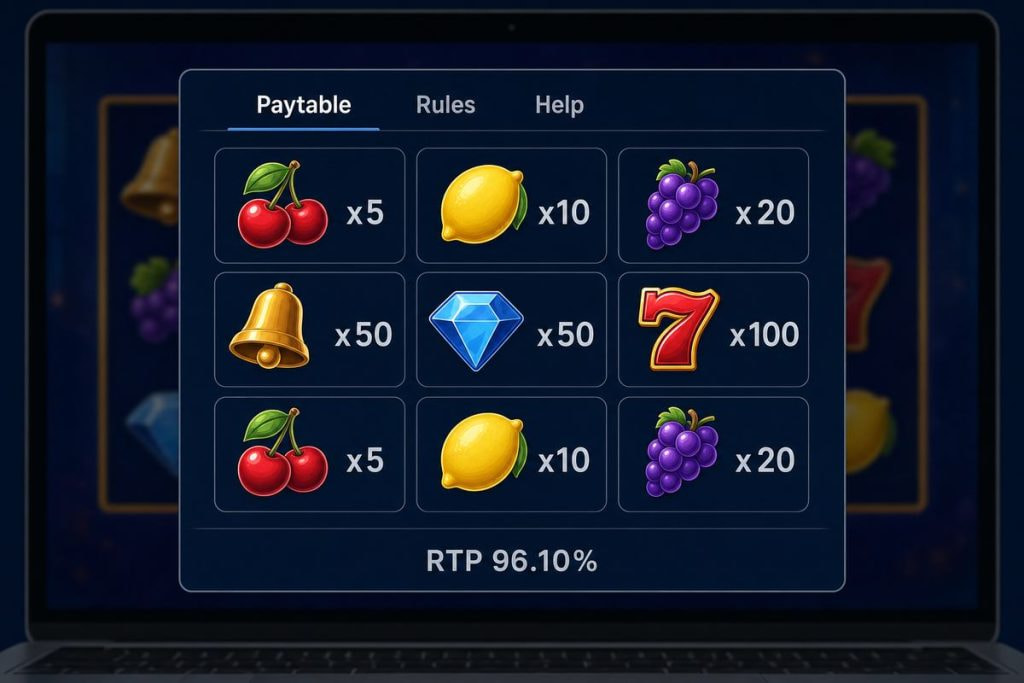
Every slot and table game on a regulated Ontario casino site includes an information panel, usually behind an “i”, “?”, or pay table button. It holds the game’s return to player (RTP), what each symbol or bet pays, the betting limits and the rules that decide how a round is settled.
It isn’t optional. Under AGCO’s standards, the operator must give you enough information to judge your chances of winning, how the game is played, and how payouts are made before you place a bet. Most players never open it, but reading it properly takes about two minutes per game.
Where to find the information panel
The button moves around from studio to studio, but it’s almost always in one of these places:
- Slots: an “i” or “?” icon beside the spin button, or a menu icon (three lines) that opens tabs labelled Paytable, Rules or Help.
- Live dealer tables: a “?” or book icon in a corner of the video screen, which opens the table’s rules and payouts.
- RNG table games: a Rules or Help link in the game menu, often with the payout for each bet printed on the layout itself.
More importantly, you don’t need to stake anything to read the information panel. Ontario requires free-to-play versions to have the same odds as the real-money game, so where a demo is available, its information panel matches the full game.
What the panel tells you
The layout varies, but most slot panels cover the same five things.
The paytable
The paytable lists what each symbol combination pays. Some games show it as a multiple of your bet, and others show dollar amounts that change as you raise or lower your stake. Check which one you’re reading, and whether a payout is per line or per total bet, because the same number can mean very different amounts.
This section also explains how wins are formed: the number of paylines, or “ways to win”, plus what the wild and scatter symbols do and what triggers the feature rounds. These are the extra in-game rounds a slot awards, such as pick-and-win games or sets of spins played without decreasing the existing balance.
The RTP
The RTP is the share of all money wagered that the game is built to pay back over its lifetime, so a 96% slot is designed to return $96 for every $100 staked across millions of spins. It’s usually a single line in the rules tab, such as “The theoretical RTP of this game is 96.10%”.
Many slots are released in several RTP versions, and the operator decides which one to run, so the figure on the site you’re playing is the one that counts. Progressive jackpot games sometimes split it into a base RTP plus a jackpot contribution. What RTP does and doesn’t tell you about a single session is covered in RTP vs house edge vs volatility.
Volatility and maximum win
Some studios show volatility as a word (low, medium or high) or a scale of icons, and many don’t show it at all. When it’s missing, the maximum win is a useful clue: a game capped at 500 times your bet pays out more evenly than one capped at 10,000 times, which has to hold that money back for rare, large wins.
Bet limits and coin values
Look for the minimum and maximum stake, and how coins or credits convert to dollars. AGCO’s standards require credit and prize values to be shown clearly, but a game that displays credits instead of dollars still takes a moment to translate.
The malfunction and disconnection rules
Near the bottom of most panels is a line such as “Malfunction voids all pays and plays.” It means a round affected by a fault doesn’t count. In Ontario, when a game is interrupted, the operator has to either pay what you’d won up to that point or return your bet, whichever is better for you, and a round cut off by a lost connection is usually restored when you reopen the game.
Reading the panel on table and live games
Table games rarely publish one RTP figure. The return depends on the rules, so the rules are what you read:
- Blackjack: check what a blackjack pays. A table paying 6:5 instead of 3:2 adds about 1.4% to the house edge. Then check whether the dealer hits or stands on soft 17, how many decks are used and when you can double or split. The strategy side is in the blackjack guide.
- Roulette: confirm the wheel has a single zero. European roulette carries a 2.70% house edge, compared with 5.26% on the double-zero American wheel, and French tables with La Partage cut the edge on even-money bets to 1.35%.
- Baccarat: check the commission on Banker wins, normally 5%, and whether a no-commission table pays half on a Banker win of six instead.
- Side bets: each one has its own payout table and often its own RTP, usually well below the main game’s.
What Ontario adds to the screen
A few things on an Ontario slot screen come from the AGCO’s rules rather than the studio, and knowing them explains why a game can look different here than elsewhere:
- Net position: slots must show your winnings minus your losses for the session, in Canadian dollars.
- A clock: the site is required to give you a way to track how long you’ve been playing.
- No autoplay or turbo: every spin has to be started by hand, with at least 2.5 seconds between the start of one round and the next.
- No fake wins: a slot can’t play win sounds or animations when you get back the same as, or less than, your stake.
A two-minute check before you play
Run through this short list before you play every time:
- Open the information panel before your first spin or hand.
- Find the RTP. For slots, 96% or higher is a sensible benchmark.
- Check the volatility or maximum win and set your stake to match your budget.
- Confirm whether paytable values are in dollars or multiples of your bet.
- For table games, check the rules that change the house edge, and read the RTP of any side bet before you place it.
None of this changes the outcome of a single round, but it tells you what you’re agreeing to before you bet, which is the point of the panel.
You must be 19 or older to gamble online in Ontario. If gambling is causing problems for you or someone you know, ConnexOntario offers free, confidential support 24 hours a day at 1-866-531-2600.