
In the fiscal year that ended March 31, 2026, Ontarians wagered more than $103 billion on regulated online sites and lost more than $4.2 billion of it. Those are the two figures quoted whenever the province’s iGaming market comes up, and neither is the amount Ontario received.
The distance between what players stake and what reaches the public purse is wide, but it is documented at every step: audited statements set out who takes a share, how large that share is, and where it goes next. What follows is that flow, drawn from the most recent audited figures rather than the topline numbers above.
Two revenue streams, not one
Ontario collects gambling revenue through two separate Crown bodies, and the money moves through each of them differently, which is the first reason the published totals are so easily confused.
- iGaming Ontario (iGO) contracts with private operators to run online casino, sports betting and poker under the province’s conduct-and-manage model. It became a standalone agency under the Ministry of Tourism, Culture and Gaming on May 12, 2025, having previously operated as a subsidiary of the AGCO.
- The Ontario Lottery and Gaming Corporation (OLG) runs the lottery, the land-based casinos and charitable gaming, and it operates its own online platform alongside the private market.
The Alcohol and Gaming Commission of Ontario (AGCO) regulates both bodies but takes no share of the proceeds. It sets the standards and enforces them; it does not collect the revenue, which is worth keeping in mind when regulatory fees and gaming revenue get discussed as though they were the same thing.
Where the online money goes, dollar by dollar
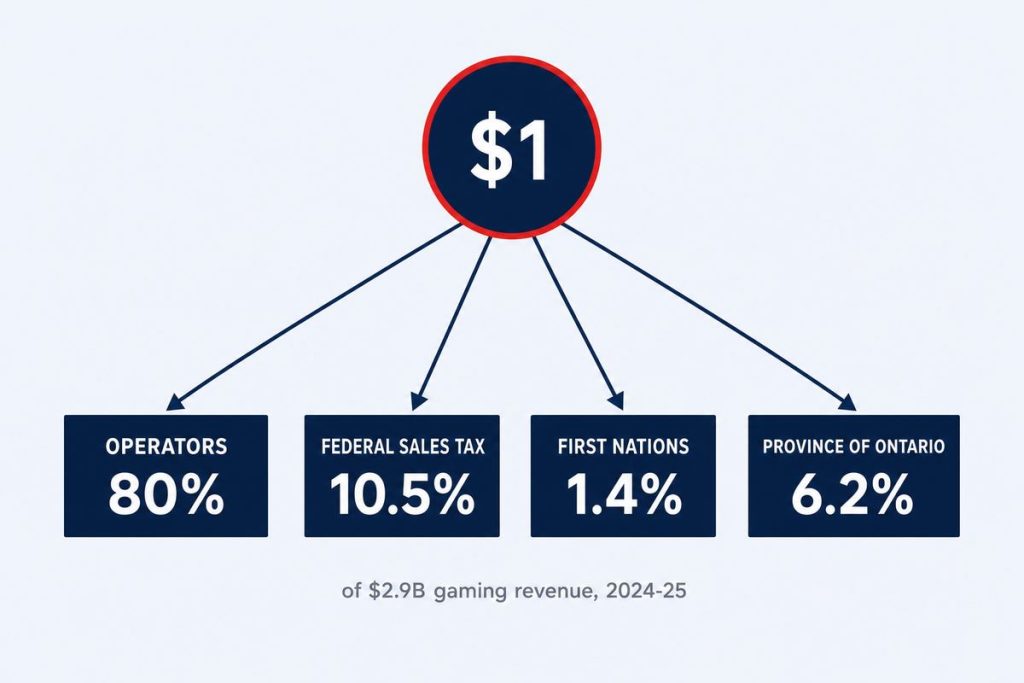
iGO’s audited statements for the year ended March 31, 2025, are the most recent complete set on the public record, so they are the figures worth working from. Players wagered $82.7 billion over those twelve months, and total gaming revenue, which is simply the amount players lost, came to $2.9 billion. That $2.9 billion is the pool every other number below is drawn from.
The audited statements divide it as follows:
- $2.33 billion, roughly 80% of the total, was retained by the operators themselves.
- $574.1 million was iGO’s share, reported in the statements as net gaming revenue.
- $304 million of iGO’s share went directly to the federal government as GST/HST.
- $41.4 million went to the Ontario First Nations (2008) Limited Partnership, fixed by agreement at 1.7% of the previous year’s gross revenues.
- $13.7 million covered salaries and benefits, and a further $2.7 million covered general administration.
What remained was net income of $218.9 million, of which iGO paid $181 million to the Province of Ontario as a dividend. That payment goes into the Consolidated Revenue Fund, the province’s general account.
So of the $82.7 billion wagered online, the Province of Ontario received $181 million. That is roughly 0.2% of the money staked and about 6% of what players actually lost. It is also worth noting where the rest of iGO’s own share went: the largest single transfer out of it was the $304 million in sales tax paid to Ottawa, not the dividend paid to Queen’s Park.
The year-four figures quoted at the top of this article, more than $103 billion wagered and more than $4.2 billion in gaming revenue, are unaudited and subject to adjustment. iGO had not published audited statements for 2025-26 at the time of writing, so the dividend the province will receive for that year is not yet known, and the 2024-25 breakdown remains the only complete accounting available.
OLG’s revenue, which is larger and much older
OLG reported proceeds of $9.3 billion for 2024-25, made up of $4,149 million from retail lottery, $4,278 million from land-based gaming and $882 million from digital. Net profit to the province came to $2.2 billion, or more than $2.4 billion once a one-time provision for a legal matter is set aside. On either measure, the older business handed the province more than ten times what the private online market did.
OLG also reports more than $1.3 billion in stakeholder payments and commissions, money that is paid out before anything reaches the province and never passes through the Consolidated Revenue Fund at all. Its annual report for 2024-25 itemizes them:
- $436 million to the Government of Canada, covering GST/HST and the federal agreement not to participate in the sale of lottery tickets
- $312 million in commissions to lottery retailers
- $186 million to the Ontario First Nations (2008) Limited Partnership
- $165 million to municipalities and First Nations that host casinos and charitable gaming centres
- $111 million in charitable gaming proceeds, distributed to about 2,400 local charities
- $102 million in direct funding to Ontario’s horse racing industry
OLG puts its total contribution to the people and Province of Ontario since 1975 at approximately $64 billion. Its own digital business is growing quickly, with net profit reaching a record $378 million in 2024-25, though that remains a fraction of the $2.9 billion in gaming revenue the private online market produced over the same period.
Where the money lands, and why none of it is earmarked
The iGO dividend and OLG’s net profit arrive in the same account, the Consolidated Revenue Fund, which is the province’s general revenue rather than a dedicated gambling fund.
OLG’s own reporting points to hospitals, problem gambling prevention and treatment, amateur sport, and local and provincial charities funded through the Ontario Trillium Foundation, which distributes over $100 million a year. It also cites Quest for Gold, which has supported more than 7,000 amateur athletes since 2006.
Once a dollar of gambling profit is inside the Consolidated Revenue Fund, it is indistinguishable from a dollar of income tax; nothing obliges the province to spend it on any of those programs, and there’s no line in the budget requiring funding from gambling revenue at all.
What comes back on the harm side
Let’s compare the amounts published on both sides, set directly against the revenue figures above.
What the province puts in
- The Responsible Internet Gambling Fund takes $3 million a year out of the province’s iGaming revenue and passes it to the Responsible Gambling Council for prevention work.
- ConnexOntario, the provincial helpline for gambling, is funded entirely by the Ministry of Health, at $4.18 million for 2025-26 following a 4% increase.
- The Ministry of Tourism, Culture and Gaming puts provincial spending on gambling-related treatment, awareness campaigns and research at just over $70 million for the past year. Critics put prevention spending below $45 million, which is under 2% of annual gaming revenue.
The cleanest pair of numbers is the dedicated fund set against the market it exists to address: $3 million a year into the Responsible Internet Gambling Fund, against more than $4.2 billion in online gaming revenue in 2025-26. That is 0.07% of what players lost.
What demand looks like
Demand for those services increases and decreases each year, which is why the funding comparison is worth revisiting each year. ConnexOntario reported close to 155,000 people accessing its services in 2025-26, and problem gambling accounted for 32% of its live agent interactions, up from 15% in 2021-22. The fastest-growing group contacting the helpline is men aged 15 to 24.
How to check any of this yourself
Every figure in this article comes from one of three published sources, all free to read and none requiring a request to access.
- iGO’s annual report and audited financial statements, which cover the private online market.
- OLG’s annual report, which covers the lottery, the land-based casinos and its own digital business.
- Ontario’s Public Accounts, which record what the Consolidated Revenue Fund did with the money once it arrived.
iGO’s monthly and year-end market reports include a note that the figures are unaudited and subject to adjustment, and the audited statements that follow months later sometimes differ. If you are going to quote a number, quote the audited one.
Conclusion
For every dollar players lost on regulated online sites in 2024-25, roughly 80 cents stayed with the operators, about 10 cents went to Ottawa as sales tax, about a cent and a half went to the First Nations revenue-sharing agreement, and roughly 6 cents reached the Province of Ontario. Four years into the regulated market, the province’s gambling income is still concentrated in lottery and land-based gaming, as it has been since 1975.
However, that concentration doesn’t make the online market irrelevant. The $181 million it returned in 2024-25 is real money that pays for real things. It’s just that if you see it described as funding hospitals, it’s worth calculating how much it funds. A quick bit of math shows that amounts to a fraction of one per cent of what Ontarians staked to produce it, and once it lands in general revenue, there is no way to trace which dollar paid for what.
If gaming revenue is a new term to you, RTP, house edge and volatility explains what it is made of. Alberta’s launch set that province’s market up on different terms, and our Ontario online gambling guide has the rest.
You must be 19 or older to gamble online in Ontario. If gambling has stopped being entertainment, ConnexOntario is free, confidential and available 24 hours a day at 1-866-531-2600.