

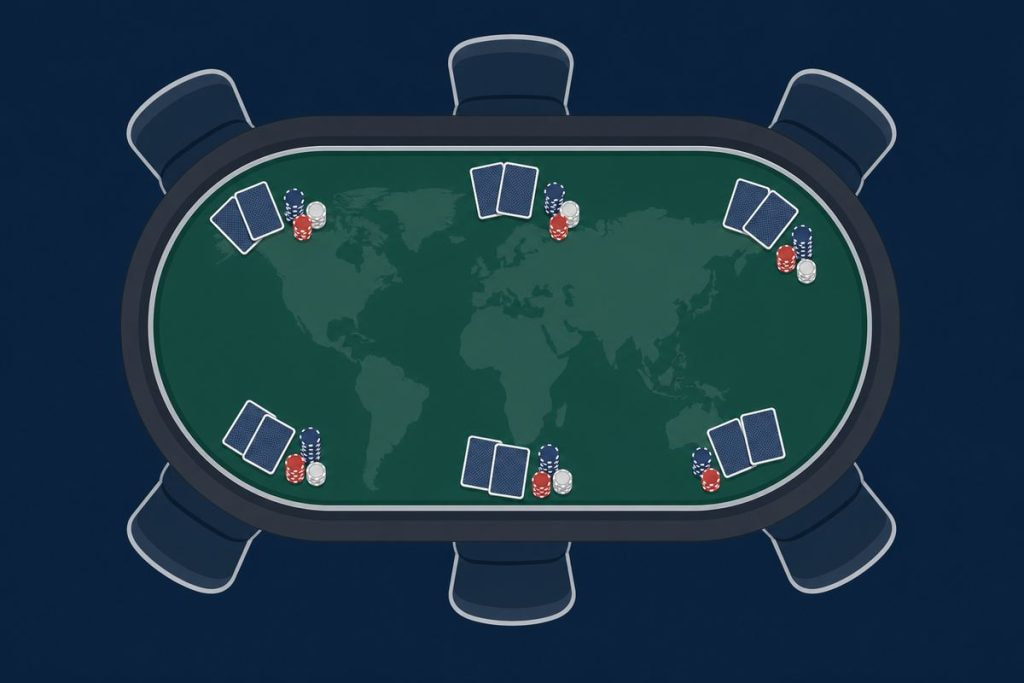
Ontario’s online poker players have only played against other Ontario players since the regulated market opened on April 4, 2022. In November 2025, the province’s top court ruled it doesn’t have to stay that way: a 4-1 majority said regulated sites could legally pool Ontario players with players in other countries.
Four provincial lottery corporations appealed, and the Supreme Court of Canada hears the case on October 7, 2026. Until it rules, the tables stay ring-fenced.
Why Ontario players only play Ontario players
In poker, you don’t play against the house. You play against other players, and the operator takes a cut of each pot or tournament entry. That makes the size of the player pool, which the industry calls liquidity, part of the product. More players mean more tables running at every stake, bigger tournament prize pools, and shorter waits for a seat.
When Ontario opened its regulated market, poker operators had to separate Ontario accounts from their global networks. Players who’d been sitting with opponents from around the world were moved into an Ontario-only pool, and it’s stayed that way. Four poker networks currently run in the province: GGPoker, PokerStars, 888poker and BetMGM Poker.
Poker is a small slice of the market. iGaming Ontario reported $5.3 million in peer-to-peer poker revenue in April 2026, about 1% of the $405.4 million total, according to iGaming Ontario’s Market Performance Report. How the rest of that revenue is split is covered in Where Ontario’s Gambling Revenue Actually Goes.
What the Court of Appeal decided
On February 2, 2024, Ontario sent a reference question to the Court of Appeal: would its regulated online gaming still be legal under the Criminal Code if Ontario players could play and bet with people outside Canada?
The model it put to the court would let Ontario players join international peer-to-peer games, like poker and daily fantasy sports, through a regulated operator’s Ontario site. Players abroad would join the same games through their own local sites.
The court answered on November 12, 2025, in Reference re iGaming Ontario (2025 ONCA 770). Four judges said yes, and one said no.
The majority: the Criminal Code doesn’t ban it
The case turns on one line. Section 207(1)(a) of the Criminal Code lets “the government of a province conduct and manage a lottery scheme in that province”, and online casino games and poker fall under it.
The majority read the section as silent on international links, not as a ban on them. They pointed out that other parts of the Code explicitly restrict international lottery links, cruise ships for example, and this section doesn’t. They also said the exemption lets provinces decide how best to regulate gambling, and a shared pool fits that purpose.
The dissent: Ontario wouldn’t be running the whole game
Justice van Rensburg disagreed on three points:
- Ontario wouldn’t conduct and manage every part of a game shared with another country.
- The exemption is limited to what happens inside the province.
- The model would bring in parts run under foreign jurisdictions, which the Code doesn’t authorize.
The appeal is built on that reading.
Who’s appealing, and why
Atlantic Lottery Corporation filed the notice of appeal on December 10, 2025. Because the ruling answered a provincial reference, the appeal goes to the Supreme Court as of right, without needing permission. The case is Atlantic Lottery Corporation, et al. v. Attorney General of Ontario, and the court’s docket lists the sides:
- Appellants: Atlantic Lottery Corporation, British Columbia Lottery Corporation, Manitoba Liquor and Lotteries, and Loto-Québec, which joined in April 2026.
- Respondent: the Attorney General of Ontario.
- Intervenors: the Attorney General of Alberta, the Canadian Gaming Association, Flutter Entertainment (PokerStars’ parent company) and NSUS, the company behind GGPoker.
The lottery corporations argue that “in that province” means gaming that takes place entirely inside the province. Ontario’s position is that a real and substantial connection to Ontario is enough, provided the province regulates the Ontario side of the game.
Every province runs its gambling under the same section, so the Supreme Court’s reading will apply across the country. That’s why Alberta, which opened its own regulated market on July 13, 2026, has intervened in Ontario’s support. Alberta’s launch means Ontario players can read more about it in Alberta’s iGaming Launch: What It Means for Ontario.
The Mohawk Council of Kahnawà:ke, which argued against the model at the Court of Appeal, told the Supreme Court in June 2026 that it wouldn’t take part, saying other parties would cover its position.
What changes for players if Ontario wins
A win doesn’t switch shared pools on. It confirms the Criminal Code allows them, and Ontario would still have to set the rules and reach agreements with the markets on the other side. If that happens, this is what a shared pool would mean at the tables:
- More games: More tables at every stake and time of day, including the high-stakes and late-night games a single-province pool struggles to fill.
- Bigger tournaments: prize pools grow with the number of entries, so a global field means larger guarantees.
- Tougher opponents: a global pool also brings in experienced regulars from much bigger markets, which matters most at the mid and high stakes.
- The same account protections: under the model Ontario put to the court, you’d still play through an AGCO-registered operator, under Ontario’s rules.
Daily fantasy sports would gain the same way, with bigger contest fields and prize pools.
What happens next
The Supreme Court set an appeal date of October 7, 2026, but has not set a decision date. There are three ways it can go:
- It agrees with the majority. Ontario can start designing a shared-pool model, and any province that wants one has the same legal footing.
- It agrees with the dissent. Ontario’s tables stay ring-fenced unless Parliament changes the Criminal Code.
- It lands somewhere in between. The court sets conditions a shared model has to meet, and Ontario designs around them.
Until the ruling, nothing changes at the tables. Ontario hasn’t announced any move toward shared pools while the appeal is open, and Ontario iGaming After Four Years: The Numbers covers how the market has grown with ring-fenced poker.
If you want bigger fields now, offshore sites with global pools aren’t the answer: none of Ontario’s protections apply there, from identity checks to the AGCO complaint route. iGaming Ontario lists every registered operator.
You must be 19 or older to gamble online in Ontario. If gambling has stopped being entertainment, ConnexOntario is free, confidential and available 24 hours a day.